3.02.2011

Art meets Ability

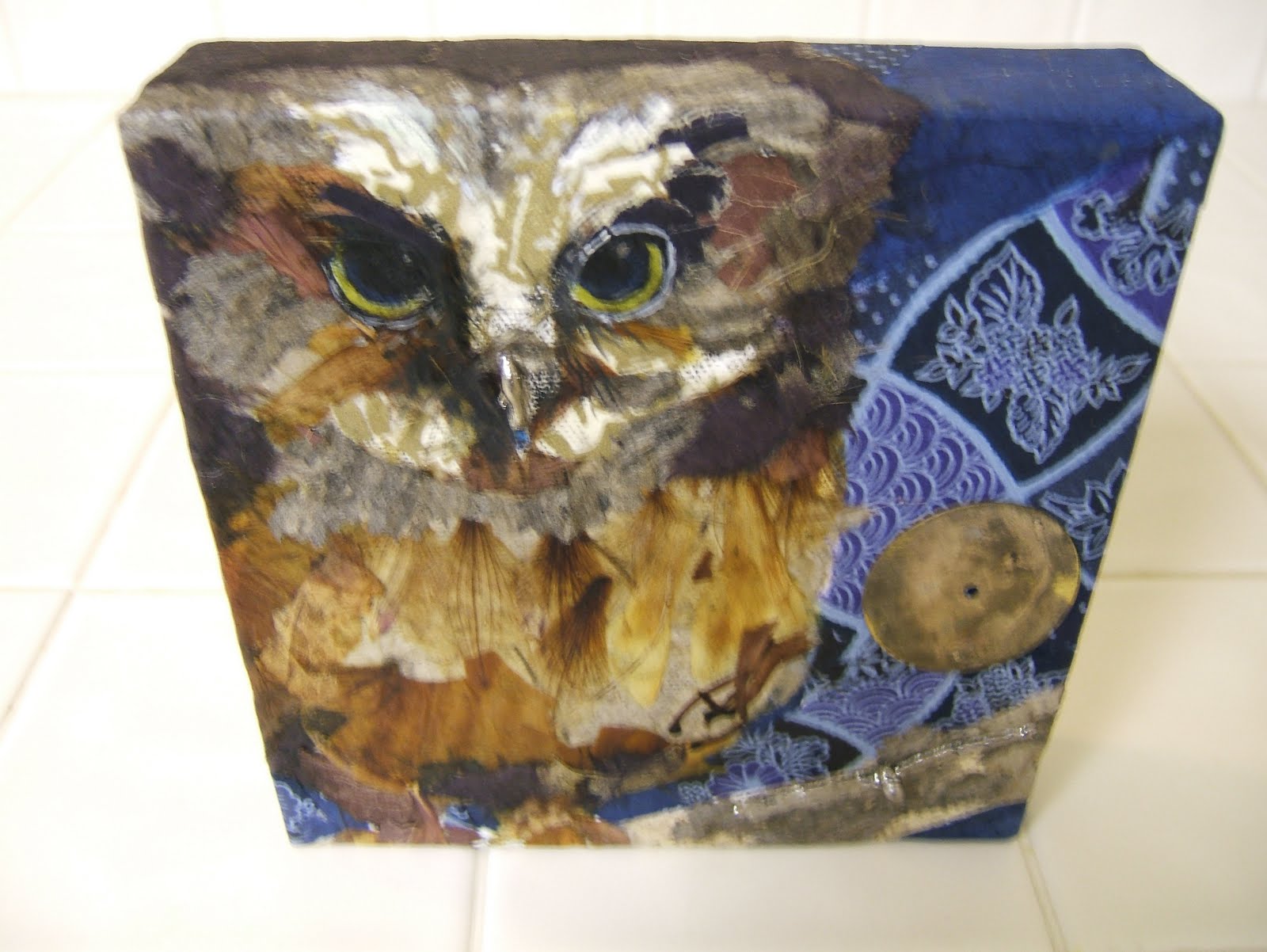
Art emerged from several months horizontal. These periods arrive courtesy of my medical condition. Salvage time again, in terms of materials, my own energy, and identity. This wallhanging was worked mostly in my couch-bound lap, using apholstery scraps, silk & batiked cotton leftovers, beads, ribbon & specialty yarn. Think of it as a walk through my body's imprints: working in the garden, studying patterns of branches out the window, walking in the woods, being in my own solitude and isolation, making internal sanctuaries in my heart to calm myself in and out of the hospital as recovery moves on, getting back balance to walk so I can have coffee & community with other people.

When the medical system can't figure out why a person has such low blood pressure they can't stand up, cough, or do other bodily functions we all take for granted without fainting for months on end, the imagination becomes a restorative space, and handwork the medicine to revive vitality.

Art meets me at my ability and pulls me forward, so that physical disability does not write the book on who or how I am.

Coffee & lunch with two friends yesterday was like getting out of prison. The joy of conversation in ASL relieves the fatigue that comes with lipreading all the time(much harder than it looks). One friend is getting her Ph.D. in Social Work focusing on disabilities. Her research & dissertation address the intersection of environment and perceptions of people with differences and just talking with her made me feel like one of these blue pods, all lit up from within.What did it was sharing how resilience, wellness, actual identity are obscured when others see the difference of a physical condition but stop there, omitting inquiry into one's personal experience.

Here's what I mean: as a late-deafened adult with Menieres & Ehlers Danlos Syndrome, a genetic condition that contributed to my disability, I grew up a musician in a hearing family but now need ASL & lipreading for receptive language, things you can't see just looking at me. There is no embroidered instruction on my jacket or tag with "instructions for use" to cue anyone: LOOK AT HER WHEN YOU TALK or she's clueless. Then I voice for myself too, making me as my daughter puts it, "a trick Deaf person" because my speech is without accent until I'm fatigued (when it gets muddled with German that was my first language). Deaf people are multiligual as ASL is not English and English is what Hearing people use in America. How "disabled" is that? Most American english speakers don't speak anything else. My new colleague was born Deaf, raised in Oralist education & learned ASL at age 20. Her English is wonderful, and she speaks fluent ASL. When is one pod just like another other pod, but not? We all grow as we grow and are as we are. My dear friend & colleague who set up our lunch is Hearing, but from a quarter of a century of embodying communication in Deaf culture as an ASL interpreter, feels individual and collective deaf experience in ways I can only imagine. She is one of the most culturally Deaf people I know, really, and fluent in English, ASL & Spanish. Meeting with them was like a walk in the forest, where I felt free to be the tree I am made, rather than searching some nursery for the right label to put on my tag.

Check out the disc shapes in the panel above. Don't they look like old-fashioned sound speakers? Art is still the easiest communication for me. It is way ahead of me: my hands always know where I am before my conscious awareness. So here's my walk in the woods: I am in an interaudio relationship with the world, the forest of other people, Deaf, Hearing, human across the continuum that comes with living in a body.

Are you appreciating your ability today, salvaging and making an art of your unique nature and human capacities?

10.10.2010

Art meets Paw

With claws, I could be a better artist. I'm sure of it. The Persian Brothers Fine Feline Wool Mfg & Distributors have them and use them in the service of softening furniture (one of their side ventures). I harvest their catwool on a daily basis.


Since the founding member of the Brotherhood died, there has been a merger with Peaches Ltd.


You can see the variation she brings into the business, with CEO-elect, ZZ Lindsey.
Their new fall line is going in a classic direction, felted neutrals, very timeless.


This time of year invokes a return to favorite themes from childhood, cats and owls, just in time for the Audubon Society's Wild Bird Festival. The cats help me over the fear of blank canvas which comes like a hiccup whenever I see the 6x6 square staring back at me each year.
Isn't there a curious relationship between these small predators?
On a personal note, I refound my closest girlfriend from the many elementary schools I attended. Somehow she and I stuck, and stayed, no matter where I was dragged off to next. I am beside myself with happiness to find her again. Somehow means that I wasn't invisible afterall. She too is an artist, and has an exceptionally close bond with animals. When I watch my grandson paint, I think of how truly children show themselves in their art and creativity, and sometimes, keep this wild soul all the way through life. She has, I have, what about you? What keeps your wild soul turning with the seasons? What thing of the past will you reclaim this month in honor of the Dead and Living? May you grab it with paw or claw and make the most of it!

4.10.2010

Art meets Refuge

Art is my immersion in joy. It is birth and cleansing, baptism in my own private Ganges and all manner of dipping into and refilling my cup.

After a wonderful show last week, and another sale, I went home like a plant when the rain wets its feet and it soaks in springtime by the roots. The marshes are welling up with water so the birds have lovely refuge for perching and eating bugs. I see almost imperceptable movement in the brush, then sense how full it is with birds. Twitches of dunn on dark, light is slivered as tiny forms flit. I see their songs now, as the water brings them to the brush dance.

I have little to add, but so much more to paint. Like gentle rain for my new world of becoming deafened this year, my old friends from the hearing world have come back to me, and my new friends in the Deaf world reach out to me. I get rain and sunshine, both. I am a fortunate plant indeed with compassionate forces to open me to springtime.

Simple things make powerful energy. Two of my friends (who don't know each other) reminded me: before enlightenment, chop wood, carry water. After enlightenment; chop wood, carry water. Paint because it is what is right to do. Do the next thing. Painting meditation is like Thich Nhat Hanh's walking meditation. Such joy. It is good to do what is front of me to do. Just that.

What is the next thing to do today? May you do it with your whole Being. It is refuge.

2.12.2010

Art Meets Brand

Brand. A manifaesto of marketing. A brand, that metal heated and used to stamp ownership, the ultimate signature of an indelible presence. It says what an artist does that sets the work apart, or makes it stick in your mind. It points to one's style, aesthetics and character but more. So what about Artimentary, the brand of Antonia Lindsey?

I admit, I come from another time and place in our culture. When small things made the big difference. The word "Art" in german means the way of something, its nature. I grew up at that last edge of time when art and industry meant more than money. Time was more than money. Time was presence of attention, a quality of focus. People made tools and many basic materials from scratch. A great portion of our economy was built on the exchange of actual, not imagined, goods and real services -- not just glimpses of them. We were makers and doers, knew each other and stood behind our words, craftsmanship and products as a matter of integrity. Way before the "superstore" concept, when communities were rich with local smaller suppliers and family-run businesses.There weren't many premade widgets, and sending far away for them meant these were precious and well-made by reputable tradition among those of other countries who also understood the inherent trust implied by the honor of a purchase. Old things were maintained and used until they could be reclaimed for materials or parts, then those were used. This was not being green, just practical, frugral and smart. Ideas were tested by actions, and actions told the story of trust that undergirded the exchange of goods and services. The keeping of the flow. This is the art in Artimentary: keeping the way of creating in mind. It's not just the what, it's the how.

What is fresh right now, whoops --that moment's obsolete..NOW is... Well you see what I mean. Ideas fly. Words hold the place for the actions...by the time something is actual it is not real, but 'old'. Notice the change in perceptions, the manipulation of our experience and how we frame it? Removes responsibility for where the buck stops. No time to find out where, what...? More of the world is a hologram. Actual freshness is for food and flowers.

American culture before the atomic era understood limits, like time, and still wanted progress but not empty promises for a dollar of hard earned money. Sure we like adornment, but waste is not wearable once the novelty passes without the transformative power of art. Iconic commercials about life in techno paradise from the atomic age made a bad marriage to insatiable appetite in America over the past 75 years. Demand can be fabricated with ads; hurried and overstimulated people confuse novelty and quality. Hooked into impulse for novelty, we mistake greed for need. Error! The new, the bigger, the better, the easier, the faster, are not the same as best. How do you define best? Stop and think.

Now the word is green, but mind the message, the product, the processes. Check for the pedigree, people. Art takes time. The handmade movement should lead in thinking seriously about what we make and how we make it. Does what we do in our craft show our time, training, good design and worksmanship? We can be self-taught or schooled, regardless, if we want to stand out, we have to decide where we stand.
Ideas to help you grow your brand:
1. Use what is at hand to the fullest, before purchasing the latest fashionable trend in medium or process.
2. Consider traditional methods then pick from the glut of innovations which will come and go like the fad of the month.
3. Pick a next theme or project by interviewing elders in your family or area who remember methods passed down through generations of artists and craftspeople. Find your roots as an artist.

Art is not yet a lost language. Some of us want to pay it forward to the next generation in the deepest sense. The joy of a process that has years of stories with it brings an unmistakeable energy. For examples check out the link to Tod Pardon, one of America's artists who keeps alive the reality and the integrity of art from which this most recent handmade movement has sprung. (Find him at http://todpardon.com). Look for the work of artists who build a relationship with their craft over time. It is all about making with purpose, not just making more. Who is oldest person you know who loves what they make? Have you learned from this artist or asked their story? Isn't this more touching than hours of crafting shows with people on TV? and doesn't it fire you up to create?

12.30.2009

Art meets Play

Art is how I play at Life. Life doesn't make any promises, and some of the packages it delivers are just plain hard to take. That doesn't mean they aren't delivered to the right address. We have the ultimate choice of learning from everything. But when I am stuck on wanting my own way, I have to bust through it and art is how I do it.

My serious nature is best composted through regular exercise of the ridiculous. I love the humor of animals, very young children, pantomime, rhyming and puns. I prefer Deaf humor and the Blue Man Group to most other funny business, because it is so intensely visual and physical. My cat is the comic yogi of all time, in his enchantment with wiggly objects. He has a ruthless hunger for play only punctuated by his...um, distinctive appearance. This pan-faced, flatheaded cat looks bit like a bass with hair...in an owl hat. He received honorary membership in Fred Flinstone's Order of the Water Buffalos as a kitten. Though I find him totally adorable and cunning beyond belief, he looks...funny!

When guest curator Elizabeth Lamb contacted me about a show of works on paper called "Play for Keeps" at the Tribute Gallery in Portland's Pearl district, I immediately thought of favorite author, James Thurber. I grabbed a 1957 book cover I'd salvaged from a torn edition of the delightful allegory, "The Wonderful O". It is a must-read tale of how the letter "O" is stolen from the alphabet, begetting all kinds of communication mayhem and what happens to restore the O to the people of the island. It is classic Thurber: exquisite, linguistically superb, hilarious and intelligent. The title alone evoked a tangent of visual puns in paper that broadcast like waves of music, enjoining other humorous takes on the meaning of "O". How can one resist a little scintillating innuendo? But I noticed after it was done, my deep connection to the orgasmic humor I enjoy because of my cat. And, well, another double entendre. Good, deep humor is as sensually tantalizing as any other joy. Smart girls know the value of a good O:

"The Wonderful O
should not be so, so.
Nay, rather it be,
spectacular glee"

Then I noticed what the piece looks like! Puns. Wow.

11.20.2009

Art meets Woods

The artmind takes over when I stare at trees. Branches stretch out and crisscross, delineating negative space and making abstract mosaics that range in compositional feel from brusque to intricate. I am mesmerized by forests.

After a hiatus, I began interpreting coastal trees again with scrap paper, magazine and upcycled titanium slag a few years ago. Some artists like the view skyward, but I prefer sidelong profiles. I like the vertical rythym of their groupings, literally their families. I take my place beside them, in the company of trunks and branches, wandering like I would the eddies of a crowd of people or a family reunion. Tree people at lunch, or in intimate discussion at a party off to one side.


I note arboreal conversations. Changing from collage to eglomise (reverse glass) painting for a recent series of nature pieces, the role of light has become a stronger means of showing their intersections, as well as open space that separates them. Connections occur at any angle, as limbs extend and fragile twig-fingers mingle. I think back to the long hikes I took throughout my childhood in some of the worlds most beautiful forests of redwood, hemlock, larch, cedar, pine and fir. I absorbed hours of forest smells, scenes, sensations and the gentle shushing of winds high overhead. My body enveloped in green, I felt sheltered in the woods, imagining the large, slow moving beings as my relatives, protectors and playmates.
My mother was born in Thuringia, what was formerly part of the Eastern block, known for centuries as the "green heart of Germany" for its groves of mountain ash, larch and needle trees. Her ache for these places brought us into the woods every month to walk and hike the sub-tropical rain forest regions around which we moved. Lonely for a sibling, she gave me a sister when I was six: a native Hawaii'an Ti plant log, which we planted and tended. This is the one member of my birth family still alive 47 years later, through her many offspring which still live in my home.

I know trees as the lungs of the world because I was brought up to seek time with them. I paint treescapes though I live in the era of urban tastes. I do this so that people who seek recreation or comfort in virtual environs will be drawn back into real and powerful places wherein life happens in rings of centuries. If we slow ourselves whenever we can remember to, we can feel roots in the ground and then we know what is necessary. What things of nature feel like kindred to you? How do you focus on these relationships or share them with others? What have others learned about our environment from knowing you?

11.02.2009

Art meets Parts

Art comes together piece by piece. I pulled some antique clockworks from bin in the studio last night, searching out elements to upcycle in the fabrication of a pin for a steampunk medal commission. It was the best excuse for playing with my Smith minitorch using oxyacetylene. With oxyacetylene gas, metal temperature moves from the solder point to fusing in a split second; it's really just too hot for most applications. But periodically, there is nothing like exploring the nature of such enormous heat in a fine-tipped, exquisite instrument like the Smith mini. I was part surgeon, part reckless adventurer. Thats an addictive place for a jeweler.

It is said you have to know the rules to break them. Flux is the layer of ground glass used to stop metal from oxidizing and preventing the union of one metal surface with another when soldering. There was plenty of excitement in fusing the clockworks to fashion a simple spring mechanism and soldering a steel flange into the jaws of a brass fitting for the catch. The surprise to me was in the finishing. I loved the combined patina of brass skin and flux. Under the high heat of this particular gas, the brass had accepted the flux, shading it like a burnished layer of enamel that captured the microscopic copper brought to the surface in the near molten metal during the process. Copper reacts to heat more quickly than the other metals, so it left its fingerprint in a most painterly way which the glass captured, melted into the thinest glaze of enamel, like a slide would what is under a microscope. Usually one cleans off the heatskin, filing, sanding, and polishing to reveal the shiny surface beneath. I could not bring myself to remove it everywhere because it fit the coloration and dimpling of a warm, autumnal planet, serving the thematic nature of the medal which captures a stormy moonlit night. It just FIT the piece. So I broke all the metalworker's rules, keeping this rough, worn, organic surface and using it as an artistic element. This is not to apologize. Why not break them in the service of this gleeful, natural magic?

I say, give me your poor (old clocks), your tired (steel coathangers) yearning to breathe free. I was in Halloween costume enjoying the treat of my amazing torch. Picture this silvery haired Deaf lady liberty: jewelers headset on, but bent over the work, the magnificence of a Smith minitorch in her grasp. Exhileration and freedom. Chemistry + art = metalwork, just like art + reUse = smart. That's the equation of this kind of liberty, to make of each piece something distinctive. A fun trick, too.

Here's my challenge: what new can you bring of your tired, poor or castoff lifestuff? Bring some liberty out of the parts and pieces. Make it count. Here's a mental medal for your efforts.

10.22.2009

Art meets Incision

Art isn't precious. Fringing the edges of owl feathers, I ruthlessly incise and scrape at the paint with the attitude of this short earred owl rendered in reverse on a glass panel. It's a tiny fierce energy I recognize in other parts of my life. I circle noiselessly for a time, but once the target shows itself, swoop down, all knotty knuckles and tearing talons. I've eaten neurobehavioral and developmental books whole, in big gulps, remembering pages and citations in the same frozen detail of a digested carcass. Friends and colleagues email to ponder various cognitive, emotional and behavioral or developmental questions, asking me to exume these informational owl pellets from time to time. My mental archive of desicated cases reminds me of CSI Grissom's shelves of samples, without the jars.

I am rivetted by birds and their ways. I imitate their tool use (yes, tools) and habits unknowingly as I fuss with my own tools, razor blades, dental scrapers, paint and interference powders, deciding how to interpret seamless contours and defined articulation of feathers, beaks, birdfeet.


I realize I unknowingly married a bowerbird.


Sculpting as they do, he strewed my path with bright objects and led me to our home in the sticks, where we make and do.

Why birds? I am unexpectedly captivated by things of the air, being a creature whose motion has lost its grace and swiftness. Their alertness is the irrestible draw. Who could imagine? A bowerbird man brought a sawhet owl woman into the bower, where we faithfully serve our three masters, the cats. Here's one of the masters now, in the repose of his own bower. Today I have no questions. I indulge, revelling in the secret symbolism of birds which pull apart the mice of the mind, leaving a soft trail of feathers as evidence of incising carnage. There comes a time when the past goes where it lives. When the mice are finished. The meal complete. The present its own purpose. I study the Master. Life is good.

10.20.2009

Art meets Language


Art is the language of my family. I finished up in my studio today and was joined by my oldest daughter and her crew. My daughter and I cooked while her husband and my grandson painted using the ancient paintbox of gouache colors I purchased back in my student days in Salzburg. Did I mention it's ancient? My daughter saw it and told six year old Kaiden, "Oh! That paintbox has been with Oma longer than I've been alive, Kai. I remember it from when I was little!" He was already settling in, at home with art materials all around him. The tradition continues.

This is how it works: give most people genuine art materials when they are young and they'll speak art throughout life, in one form or another. We paint, eat, live a handmade life, and set our own pace. Art is engrossing without being overstimulating. Our bodies love this. Art really IS our air. My question is how will people know this relief, this pace, unless they take several steps back from the virtual world? What is the value of art beyond the objects? How does creating it play a role in your relationship with the environment?

10.16.2009

Art meets Shape

Art works it's way out of my backbrain. I am watching shapes. It occurred to me when the last owls were done, that they look like pansies in some night forest. The face discs of owls have a layered quality, which truly evokes the same kind of soft planes I notice in certain flowers. I didn't consciously realize this until I found myself digging in with my close-ups on this rose.

No sooner had I explored a series of shots and lighting trying to capture these soft but explicit layers, when an OBP special on raptors provided parallel imagery in the facial discs of owls. Here is the shot directly from the TV screen which captures these shapes as they change surface to coordinate sound with visual targeting. The feathery discs are actually acoustic amplifiers of the grey owl's unevenly set ears. The disc shape is constrained or expanded by subtle changes in facial muscles as the bird's eyes follow a target. This information, combined with the hearing data, gives the owl stereoscopic precision for locating and hunting prey. As I work with depicting these beloved things of nature, I am amazed at how my visual brain leads me into their physiology. Then into my own.

I am a raptor-like observer with a brain that doesn't easily turn off. This is a factor of physiology, my own human sensory system, which registers numerous sensory inputs all the time that I hardly reflect on until I've reached overload. I find it necessary to trust this encoded information, and to allow it a voice in visual expression. Otherwise I am too easily overwhelmed by the sheer volume of daily input, visual and movement stimulation, and become fatigued. How do you process and recycle the numerous shapes and images that surround you? Do you realize how overload can leave you exhausted, paralyze you with too many choices, for example in stores, so that you are get overwhelmed and manipulated by false 'targets' (food or other comfort items that don't meet your real need for relief from overstimulation)? The paralysis of too much!? Time to learn our own natures again.

10.10.2009

Art meets Night

Art calls after midnight. Like some shadowed visitor I open the door to, compelled but uncertain. Of late the wee hours are more appealing than any other time of day. I'm turning into my subjects.

Owls are as irresistable to me now as they were when I was a small child. I have always been taken with the birdpeople. I struggle over how to capture their rapt attention without losing their complexity of gaze. It is the same with doing justice to cats and other predatory animals. Those with hunter anatomy and physiology, who can in a moment become the hunted. That's the edge; this dual instinct under the surface. Vulnerability has to be there, but may not be overworked.

As humans, we seem beset with projecting predatory qualities onto everything around us, then portray our own species as victimized but heroic. It is a dreadful lie, having taken over the terrain, food, and general environment of every living thing on the planet. Staring at the owls helps me be honest. What do you think?

10.02.2009

Art meets Reverse


When it can't go forward, art goes backward.
I found my way back to reverse glass painting in honor of a former teacher. Joze Ciuha is a Slovenian artist of international acclaim who is known for his provocative, politcal and exquisite work in this technique. I remember studying in Salzburg with him in 1974, doing days and months of figural studies, while his show of impressively large oil & glass panels hung in one of the city's prestigious galleries. His topic was "generals" before the fall of Tito, when Yugoslavia was a still a Soviet satellite. The immense portraits featured chimpanzee faces in generals' attire with cyrillic inquiries, commanding and unforgettable.

When Art Media, Portland's cherished art supply store, announced a workshop, I lept at the chance to join Karin Boe-Hadley and immerse myself. Work is planned and executed in reverse, beginning with highlights and ending with background, which is often goldleaf (or similar metal leaf). It provides complete respite from other thoughts.

Fall has started off with this tiny portrait and relief to have another opportunity to reclaim glass, images, ideas, and fond memories of sketching with Joze at the Salzburg Zoo where a particularly clever monkey tricked me out of my pencil when I mistakenly thought he was aiming for my figs. Art can still trick me like that monkey. Sometimes I have to turn back, to move ahead. What reversals have brought unexpected gifts in your life?

8.06.2009

Art meets Staycation

I've gone to the birds. Friends, I'm on staycation. I spend my days watching and sketching birds in the healing garden, planting the fall food crop, and deep learning ASL. Like a fish in a glass bowl, the hearing world is harder and harder to access, so I'm sinking into the visual and kinesthetic world where my senses still bring connection. I'll be back after filling my cup. Wishing you well in the interim! Namaste' and blessings, people!

7.20.2009

Art meets Rhythm

Art has its own pace. Living a green life helps me appreciate the role of time. There is no rushing the way raw input gets composted down into the richer soil of my own images. Sometimes this means years before I address a certain subject, other times there is a more immediate translation. Our current culture does not recognize long intervals wherein something germinates in darkness for an undetermined period until converging factors call it forth. Underestimating this deep mystery we can miss an awful lot. Artists are often told to go look at others work, and feeling guilty, I knew I had to avoid this. I did not know why, I just knew my art worked better for me when I didn't overload with others' imagery. Now I know I was busy composting and didn't want all that heat dissipated.

I know of nothing so close to nature as this strange inherent thrum wherein deep calls to deep. At the Zumwalt Prairie in eastern Oregon several species were nearly eradicated until they designated the area as sanctuary. After just a few years left alone, the species had mysteriously restored themselves. Letting be is sometimes the greenest of all practices. Leave undisturbed. Buddha put it "Muddy water let stand becomes clear".

I somehow learned to count on the slow drip method of letting my own images emerge from experiences 20 or 30 years ago. Then I was only soaking in the sensory and trying to find my part in all that three-dimensional music of interaction. Now is when the highlights sort themselves out. I count on that now, relax into it, where I never could before. I am not concerned with where the next image will come from. I only wonder how things will look when my body translates them, surprised by what it wants to recall or recapture in another form. This is the essence of what the green movement does; allows us to recognize and appreciate how one thing, then another impacts life and how it is returned, restored, or reused to serve a larger cycle.

(Strait in the San Juans) refers to cherished time in the San Juan Islands of Washington. As a teen, I worked in art and dance at a camp run by Karlyn Kaiser, the granddaughter of industrialist, Henry Kaiser, where the graceful schooner, "The Martha", built in 1906 by Stone, took children from established families around the straits and harbors of Orcas and other islands. It was another world to me. What I connected with most was the motion of water, the current and thrust of waves which were translated into my feet as the huge boat beat its way through the Straits of Georgia at sunset. That's when sailing got into me, when water assumed its stature, becoming the force in my life that a piece of land becomes to most people and their families. I believe it is when the rhythm of my feet met winds of spirit in a new way, and I no longer felt like an island alone. When it became possible to trust the current, to see beyond controlling to navigating with the forces as they come. Water has its own ways. This element largely governs my art. Such a gentle and powerful force, it even penetrates stone, which is why I trust it to seep through and come out despite all the sediment of life. How it works is a trustworthy mystery. This is where I learned to accept and count on the next wave.

6.29.2009

Art meets Angel


Art is angelic. This is no mild descriptor. I'm not talking about angels in the the popular way. My imagery is far from the greeting card cherubs with dimpled bottoms or church window baroque figures swathed in serenity. The historic texts about angels reveal them as disruptive, potent beings. Contact with them left the beholder shaken and amazed to the bone. Abraham was alarmed, preferring they not even visit his tent if instead they might please go bother someone else. I know the feeling. Art has its own vantage point. Whence it comes and where it goes is like a map that only makes sense of from the air, rather than on the ground where perspective is organized by your immediate take on the surrounds.

I armwrestle in my relationship with it and have since I was a child. It didn't always obey my mental intent. Dori Lohr, a painter turned enamelist who I knew in school told me early on, "Don't fuss about your art when you are young. Do your music first. You have to do it first because of the instrument. It has a more limited lifespan, the voice. Paint will always be there. Metal will always be there." I was perplexed and had no concept of what she meant. I did all forms, but took her advice and did the music while I could. Now that I am deaf, imagine my relief that the angel of visual art is not a jealous lover.


But as angels do, it brought omens. I found a gouache sketch I made in graduate school. I had always wondered why the figure wobbled on unsteady legs, why the legs and ears were both green. Now that I understand the link between hearing and balance, the mysterious double features directed by the eighth cranal nerve, I know and it takes my breath away. What surprises has the Archangel Art brought to you?

6.26.2009

Art meets Green

Art is sneaky. It turns you green. Having dropped off the cliff of the hearing world into the ocean of non-silence that is my deaf world, I am the Siamese cat who howls this song in the stairwell to her internal orchestra while the rest of the world keeps on marching. I need now, more than ever, the music of my hands, as I recycle myself. I need art to convey the burden of purpose. The purpose? Halt the march. Art is the way I green my attitude towards change, and point others towards repurposing how they live and what they do.

A writer for a local newspaper interviewed me this week, a really nice gesture that comes at a poignant time. She asked about the word "reUse", and a curious discussion of art, eco art, recycling, upcycling and greener living ensued. A curator, Elizabeth Lamb, first framed it in words that rang true for me: "There's an automatic association between reUse and the roughhewn, worn or used up which is a barrier to reUse art being taken seriously in the Art World." I think it is even bigger than that. The zeitgeist of the Atomic Era seeped into our national mindset like so much plastic, leaving a contemporary construct that remains actively unchallenged. Commercials bathe us in a mental potion of manipulative language and imagery about 'new, better, improved' that has, literally and figuratively, poisonous consequences. We buy at our own risk. An endless addictive cycle of annui, thrill then disenchantment attends the proliferating and hungering for the most current (aka better) consumer goods. What is it about humanity that we are such suckers for novelty?

All this failed me during the interview. Words are not easy for me. I reached for my basket of feline fur and needlefelting, to show the simple process of felting the material for jewelry projects such as this Mandalacat Amulet which is made of 15mm glass beads, reclaimed sterling cable (or guitar string), upcycled leather, a vintage button and, my wool of choice, persian cat fur.


What I should have said was that most American children probably think felt grows in 12" square blocks on a colored felt tree at a craft megastore. Instead, I learned about felt yurts and shelters in Central Asia where my mother's people came from before immigrating to Germany. For millenia, people have been shearing goats, sheep and other animals, boiling and matting this versatile fibre for everything from walls and doors to coats, hats and shoes. I'm not innovating at all. I use what is at hand, as people have always done. Think of the unique Chinese gardens, where broken pieces of pottery are worked into mosaic amidst local stones. Examples are everywhere. Quilling in the work of Lakota artists, caribou tufting by the Dinendeh. An early mentor, calligrapher Inga Dubay, who restored the art of beautiful writing to Oregon's school system through the Getty-Dubay method, put it best: "Use it up, wear it out, make it do or do without".

Back to the burden: I am stunned that greening life is considered a new idea. It is traditional. It is what people have done since time out of mind. Things which were made from the earth return to it and become grist for something else. Cities rise and fall and new cities are built atop the previous ones. In America, we forget this. This land was full of art and culture when Europeans came here and built over and against the active cultural traditions which were in progress. The neo-industrial world overshadows the agricultural proclaiming itself bigger and smarter. It's the same old story in new clothes. Since when is common sense an innovation?

Living greener is about returning. Trusting methods that were time-tested over generations. Being content to be temporary creatures of a time and a place, instead of having to be THE time and THE place in some grand sense. I feel the most important thing I can do, as an artist, is pass this tradition on to my loved ones and friends: take what is at hand, and let this become transformed by caring attention into a message of purpose and appreciation. To be greener, attend in a new way. To be an artist, listen inside and let your attention be drawn to a new mechansim of expression as your hands make music with the ordinary. Think, what else can this become? Or in life, what else can I make of what is at hand?

6.17.2009

Art meets Ocean

Art is prophetic at times. The bodymind announces itself in pure form, as clearly as a gasp. The depth of the visual conversation with my own body, through art, stuns me. The emotional key is heard immediately, followed by a wake of thematic overtones and harmonics that ripple outward. The broad wake, a mental mirror that is as bright as the brass hardware of the moon in this mixed media piece, "Of the Ocean" (c 2008).

This week, recovery from surgery forced me back to the website at Johns Hopkins. I discovered the euphamism for Meniere's Disease is the "otolithic catastophe". Public opinion would appear to support this. The stares and vague disgust in others eyes when they watch my faltering gait and balance offers daily evidence. What do you do when you see an alert-eyed woman of 54 lurching like a broken stork, arms windmilling erraticly like a swimmer drowning on level cement? People think one thing: drunk. I lurch along slapping ashore to the nearest wall or other vertical surface, clinging to these rocks to stop me from being swept back out to sea. I ask people to speak slowly so I can lip read. Exhaustion. [Dunes Day with Silver Lining, c. 2008]


I look to art for comfort even as it strips away denial. At least I can remake the environment symbolically, reclaiming lost treasures from these depths. When pain and nausea stole sleep again in spite of fatigue, everpresent as a fog bank at sea, Of the Ocean unlocked to me the secret of its strange spacial duality. The spliced space has been somehow accurate and annoying. Like adjusting your eyes to see a page, while simultaneously looking through a magnifying glass at it. Bifocal. Though I knew what effect kept flattening the space, the haptic patterns, I could not account for why. Why did I need to splice depth and flatness together in one piece? It hit me. This evokes the moment when swimming, you survey the horizon, then eyes open, slip down beneath surface tension into the pressured underwater world. Water overtakes all sensation and perception, as you move through wet space like some astronaut in a skin suit. This the window into my daily Mystery, a personal icon. It's message broke through as I worked to manage acute pain and pressure from the new shunt in my mastoid. The puzzle connected in my body, letting me weep with relief as well as anguish. The duality now made sense, bringing comfort, though there is no exit. Life is not without pain, that's non-negotiable. Thus, which would you choose; pain without, or pain with meaning? Pain is. The meaning is of our choosing.

I will live as a zebra, striped with constrasts. ["Zebra" c. 1997, E.P. Whitlock] I'm stuck between the hearing and deaf worlds, the walking and the wheelchairs, 'normal' healthy and the disabled or differently abled, German but American, recovering but looking inebriated, the list goes on. After 26 years of being an Art Therapist and Consultant at the local and national levels working in research and clinical intervention for neuroatypical children and their families in the field of Fetal Alcohol, other Drug and most recently, Methamphetamine Effects, I am now the hard to diagnose and treat patient. The ad would say "sea-zebra under the waves seeks kin of Jacques Cousteau and other explorers to join navigational adventure into blue beyond. All activities to be conducted at 40 ft below the surface without equipment." What contrasts do you reconcile, and what meaning do you take away with you?

6.13.2009

Art meets Object

Art is my Way. And my object. I promised I'd show you some good out of all the hairballs of my life in a previous blog. Okay, meet the felted nouveau Edelweiss!

There is this distinction in the arts, the Fine versus the Applied. The High and, then, ahem, the Low. Art (the rarified ballet slipper) and Craft (shoes cobbled by hand). As a lifelong maker-doer the whole dichotomy is objectionable. What is the hierarchy of making objects, save some qualities of origin or what passion asserts their arrival: when exactly do instinct and practice conceive art? Abstractions are imposed after the fact. Invalidation also. I hit the wall in every sense this week. I could not sit to ease my ache to work in larger pieces as my heart broke with fear. Don't diss my Edelweiss, world, I warn you. I mean what am I actually going to do, run down debilitation and gesticulate at it? well if I could...but I couldn't get my hands on a walker.

There is the devotion to making and doing, and then those who cannot or will not show up in their own lives enough to grab on and wring out of being alive whatever satisfaction they can, facing up to the endless losses and changes with at least some curiousity. I refuse to be in-valid. So, sobbing, I stab into the furballs, to slice, carve, do surgery on them. Make of the food for a vaccuum something one would reach to touch instead. I am not ready to be thrown away. How do I feel about powerlessness? Inability to push ahead my own mending from this last operation to my head? I used razor blades and big shears on those soft, round orbs, the hairball skulls.

I cannot enjoy being this disabled. After years as a professional helper I cannot help myself or force myself out of this disease that steals my life in chunks. I danced classical ballet 4 times a week, 3 hours a day from ages 5 to 14, then ethnic dance my entire life. I feel humiliated as I struggle to stand and windmill like a broken stork until I end up a plank on the floor. I performed music when my mother, a coloratura, stopped singing. Now I can't hear the most precious sounds, or even necessary ones; the doorbell or locks, having no indicator but cats dashing that something comes around. Fear, this is the worst part. What happens, the falling, the silence, these I can learn from. Edelweiss object to crippling fear.

Art is how a curious mind gives courage to hands. I venture into what I don't understand and use my eyes and hands to recycle fear into something else. To make some use of reactions that would otherwise paralyze or overwhelm me. I make and I calm down. This I learned as a little girl from the screams and sounds, being unable to make large people stop brutalizing those who weren't as big. Like I said, she stopped singing. Completely. Unless I sang descant to her melody, then she was not alone. Audible screaming had to be muffled or transposed into something. She sang until she couldn't. I may be pinned and unable to escape, but I leave visible proof that someone was there. Someone you should wonder about and search for. It may be as slight as the torn napkin flowers I left at the counters of the gas stations or cafes before he'd force us back into the car, moving again, to the next neighborhood where no one would stop him or call the police.


Art was always my bigger voice and strongest signal. It gives me rights. I am able. I am valid. I can express anything, everything, honestly, deeply or as bluntly as I will. If my challenge has always been to make something out of nothing, why not Edelweiss from hairballs? But now you know their pedigree. These are the fleshy cousins of those lost napkin flowers. Delicate species but a sturdy genus. They are my objects, my objections, aren't they? Who would know seeing them on a shoulder bag, or hat, and read their actual message? Would you have guessed? Now this: what was my mother's favorite song?

6.12.2009

Art meets Unknown

Art has always been ahead of me. This dinner plate emerged out of a time of upheaval, as appearances fell away, doors closed, windows opened and simple fixtures of life were swept aside, including, ironically, my place at the table! The outside world was in flux, and my internal landscape was a moving mosaic.

After a divorce and 2 floods, my children and I moved back to land from 5 years of living aboard a 44' sailboat outside the Sauvie Island Wildlife Refuge. Our family was immersed in the ways of birds and animals on those woodsy banks. The flooding in some areas was a seasonal occurrence, but we actually faced 2 major disasters which left the world swollen with fouled water, contaminated by cow corpses and other stranded animals. Yet, unbelievably, the community rallied and by 10 months time, surroundings and people had largely recovered. In the beautiful times, there was nothing like living richly with wildlife, while sparsely with electricity and other resources, maintaining a handmade life aboard. It was an important period which left me and my daughters stripped down and grateful for essentials. We hit our cultural detox from typical American consumer mentality hard and early.

Once in a house that didn't move (boats are always in motion even at rest) visual art resumed its primary role. I salvaged fiberboard and test glass pours from a local art glass manufacturer. Their dumpster filled weekly, and they let me glean all manner of slabs. The moving mosaic of my interior life on the water was breaking itself out of me piece by piece as I made this large work freehand. Instead of using traditional methods of tesserae, which are highly uniform, I needed the freedom of varying glass shapes and sizes and working directly onto the board with adhesive, without sketching. We think of drama with seascape, but the river is a subtler world of contrasts. There was an immediate and panoramic intensity to those days on the water at the confluence of the Willamette and Columbia rivers. The force of the river was fast each spring driving up through the bottoms of trees in the wash, while the boughs greened up and clouds stretched their wings. I was wrenched by leaving, and struggled to trust I would not be ultimately washed away in all the loss. And I was not.

Aboard a boat and in the sailing community, I maintained the ballast of my own identity through music and dance. 3 years after returning to land was when the diagnosis of Meniere's Disease was made. I brought the sea back in my body, always seasick and dizzy. Dance has been passed on to my daughters instead. Menieres has progressed so that I cannot tell when I will fall; some internal lighting strikes and spontaneous face plants occur out of nowhere. But, it has left my visual art which like this mosaic, still has it's own internal press. Art still leads, and now what I do with my hands reflects more and more my choice of how to navigate the rough waters of particular physical limits on a given day or over a period of time. I see music now. I see bird songs, breeze in trees, as deafness changes my senses. What helps me now is to enjoy this visual music and dance of my hands in the art. I recycle everything I can, from sensory input to my own physical being, moment by moment as if under the water about 40 feet. Each day is it's own and all I can handle. The inside story of the mosaic just means more now. The plate tells more than I knew at the time. I am facing an even bigger unknown within this body culture than any I have learned about before. I trust art to show me what comes next. Fortunately, I don't read it as I do it. I treat it more gently than I have my body, a hard lesson now. But more than ever before in life, it is how I will express my culture and share it with you. What leads you? What gives meaning to your unknown?